
Maybe you're the one everyone relies on. You remember the birthdays, hit the deadlines, answer the email at 10pm so nobody's left waiting. People describe you as capable. Organised. "I don't know how you do it" is something you regularly hear. You smile and shrug, because the real answer would take too long to explain.
Because what they don't see is the hour you spent rewriting a two-line message. The conversation you replayed on the way home, checking for anything you might have said wrong. The work that "should" have taken an afternoon but took until midnight. The way one small mistake can sting for days, even when everything else went well.
However much you get done, it never quite feels like enough.
For many adults with ADHD, perfectionism quietly becomes a way of coping: staying on top of things, keeping criticism at bay and holding on to a sense that you're okay. It often works, for a while. But it's exhausting, and over time the very things that help you succeed can start to wear you down.
You can keep your ambition and still get curious about why achievement started to feel like the price of being acceptable, and whether you still want to keep paying it.
Is perfectionism common in people with ADHD?
It can sound like an odd pairing. ADHD is so often associated with being disorganised or forgetful, and perfectionism sounds like the opposite. But in therapy, the two turn up together a lot. Perfectionism isn't a core feature of ADHD, and plenty of people with ADHD don't relate to it at all. For others, though, it grows up alongside ADHD, almost like a protective layer.
Think about what it's like to spend years hearing that you're careless, scatty, too sensitive, or "so bright, if only you'd apply yourself". At some point, a lot of people quietly decide: I'll just have to work twice as hard, so nobody can say that again So you overprepare, in case you forget something. You check things three times, because you've slipped up before. You set the bar sky-high, because the thought of someone spotting a mistake feels unbearable.
Researchers are starting to name this too. A 2026 perspective article in Frontiers in Psychiatry describes how perfectionistic overcompensation and constant self-monitoring can hide ADHD-related struggles in adults who look, from the outside, like they're doing brilliantly.
Of course, perfectionism has lots of roots: personality, family expectations, workplace culture, past experiences of criticism. ADHD is just one possible thread. What matters most is understanding what it's been doing for you.
When achievement becomes tied to your self-worth
Wanting to do something well is a lovely thing. Feeling you have to do it well in order to feel okay about yourself is something else.
It often shows up as a quiet running commentary: if I get this wrong, they'll realise I'm not actually that capable, or everyone else seems to manage, so why can't I? Asking for help starts to feel like admitting you've failed. And there's always the promise that you'll finally relax once this next thing is done. Except when it is done, the relief lasts about an afternoon. Then the goalposts move, and what felt like an achievement last month becomes the bare minimum you expect of yourself now.
Research backs up the idea that it isn't ambition itself that hurts. Studies of perfectionism separate striving for high standards from perfectionistic concerns, the constant worry about mistakes, criticism and falling short. It's those concerns that tend to go hand in hand with lower self-esteem. Self-esteem difficulties also show up often in adults with ADHD, though everyone's experience is different.
The cost of always being the capable one
For a lot of neurodivergent adults, being capable isn't just something you do. It becomes who you are. The responsible sibling. The one at work who never drops the ball. The friend who always has it together. Those roles may have given you real things: recognition, security, a sense of belonging. Especially if they were how you made up for difficulties nobody else could see.
But when your sense of self rests on always being capable, struggling can feel genuinely frightening. Rest comes with a side of guilt. Accepting help feels awkward when you're usually the one offering it. You can be endlessly kind about other people's bad days while giving yourself no slack at all.
Underneath, there's often a quiet fear of being found out. Many people with ADHD also describe criticism landing much harder than it seems to for others. (You may have heard this called rejection sensitivity. It's a widely used term, though not a formal diagnosis.) So when life gets harder and your capacity dips, it's rarely just frustration that comes up. It's shame. Not "this is hard", but "I'm not good enough, because this is hard."
If you were diagnosed later in life, this can hit in a particular way. Looking back, you might suddenly see how much energy went into masking: hiding or overriding your difficulties so you could seem as capable as everyone expected. That can bring relief. It can also bring grief, or anger, and some big questions about which parts of you were truly chosen, and which grew around expectations that never really fitted.
All of those feelings make sense. And you don't have to sort through them on your own.
How perfectionism and ADHD can lead to burnout
There’s a task that feels big or vague, and you can’t quite see where to start, yet it also has to be excellent. So you put it off, and the longer you leave it, the louder the anxiety gets, until the deadline arrives and urgency finally carries you through a late night of adrenaline and cold coffee. The finished work is genuinely good, which is exactly what makes the pattern so hard to spot. Because the result looks effortless, nobody sees what it cost: people say “great job”, you say “oh, I managed it in the end”, and the hours of dread, the late nights and the crash afterwards quietly drop out of the story.
The same Frontiers article argues that this hidden effort deserves far more attention, because someone can look successful while carrying a great deal of distress and exhaustion underneath. But getting something done doesn't mean the way you got there was sustainable.
Round and round: the ADHD overcompensation cycle
Zoom out, and that story often turns into a loop. Each stage makes sense on its own, and each one quietly sets up the next.
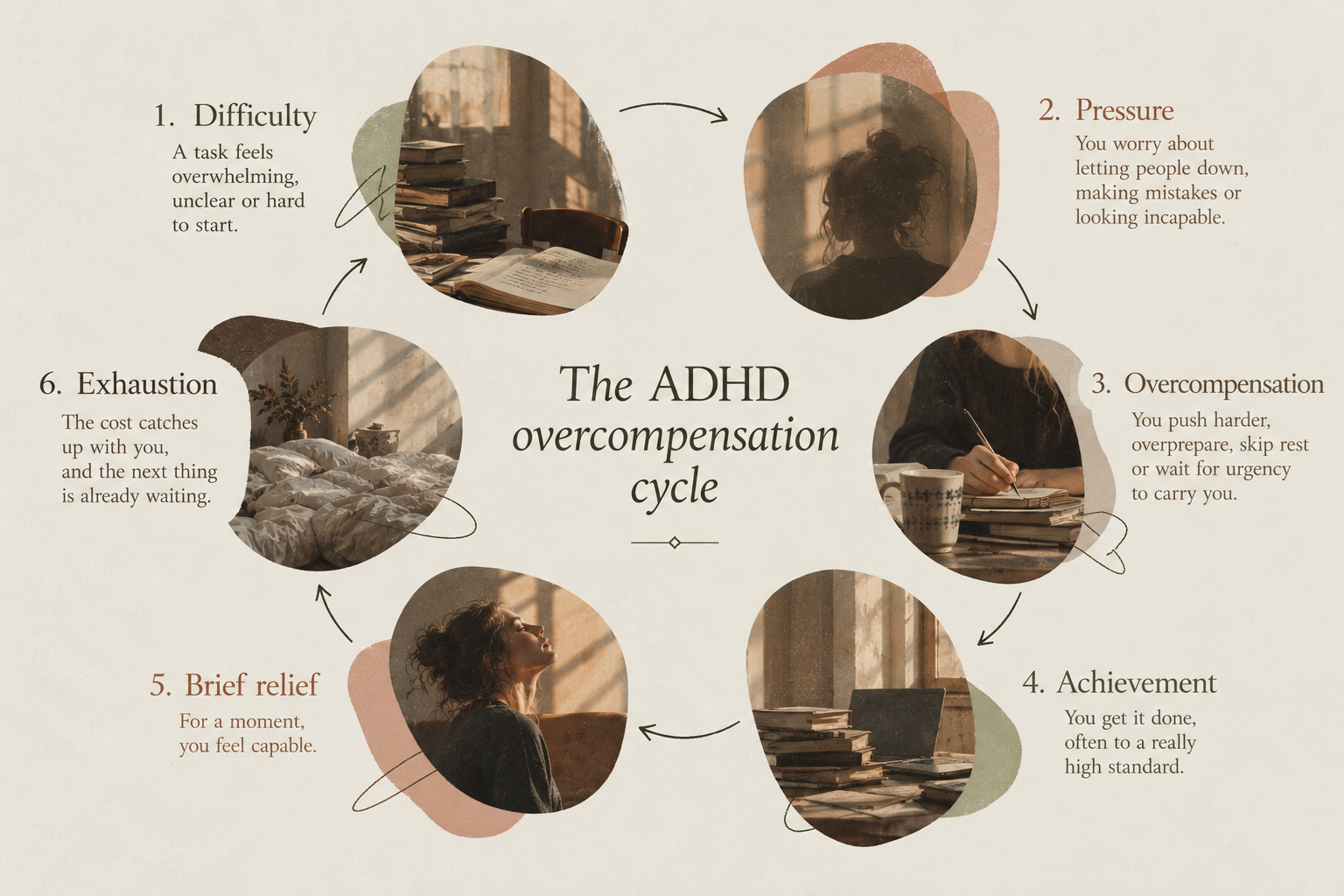
The sneaky part is stage four. Because all that effort pays off, the whole loop gets rewarded, and next time it feels like the only way to get anything done. Meanwhile, the relief at stage five rarely lasts long enough to actually recover before stage one comes round again.
Go round that loop enough times and it starts to wear thin. You might notice you're more tired than sleep can fix, more irritable, struggling to concentrate, or that everyday things feel heavier than they used to. People often call this ADHD burnout. It isn't a formal diagnosis, but it's a very real experience.
And it's worth saying clearly: burnout isn't only about how you cope. Workload, money worries, discrimination, caring responsibilities, health conditions and environments that don't work for your brain all play their part. Sometimes the problem isn't you. It's what's being asked of you.
Why "just lower your standards" doesn't work
If it were that easy, you'd probably have done it already. "Lower your standards." "Take a break." "Stop worrying what people think." All sensible advice, and all surprisingly hard to follow when perfectionism has got tangled up with feeling safe, belonging or being good enough. You can know a mistake doesn't make you a failure, and still feel the hot rush of shame when you make one. You can know you need rest, and still feel guilty the moment you sit down. You can want help, and still find asking for it excruciating.
When advice this sensible won't stick, there's usually a good reason, and it can help to get curious about where these feelings come from. A few questions to sit with:
When did mistakes first start to feel so dangerous?
What did achievement mean in your family, at school or in early relationships?
How have your ADHD-related difficulties shaped the way you see yourself?
Who are you allowed to be when you're not being useful?
You don't need answers right now. Simply noticing which question tugs at you a little can be a starting point.
How therapy can help with ADHD perfectionism and burnout
Therapy isn't about fixing you, teaching you to be more organised or talking you out of your ambition. Good neurodivergent-affirming therapy starts from the idea that there's nothing wrong with how your brain works, and that the strategies you've developed made sense at the time.
It's a space to slow down and look at things together, at your own pace. That might include:
Getting to know your inner critic. Instead of trying to shut it up, getting curious about what it's been trying to protect you from: rejection, judgement, being found out.
Separating your worth from your output. Exploring what success gives you emotionally, and why slowing down feels so risky.
Working with your real capacity. Noticing the difference between what you can do in a push and what's actually sustainable, and thinking about boundaries, rest and reasonable adjustments. Sometimes it's the environment that needs to change, not you.
Feeling, not just understanding. Many people with ADHD can explain their patterns brilliantly. Therapy can make room for what you feel as it comes up, so it doesn't become one more problem to analyse and solve.

Work with Charlotte Clegg on perfectionism, professional identity and burnout
If this feels close to home, Charlotte may be a good person to talk to. At Common Ground, psychotherapist Charlotte Clegg works with neurodivergent adults whose sense of worth has become tangled up with work and achievement, drawing on her previous experience in senior corporate wellbeing roles.
Using relational and parts-informed therapy, she helps clients explore where their sense of value comes from, what matters to them beyond what they achieve, and how work may have shaped the way they see themselves. Alongside recovering from burnout, her work makes room for reconnecting with the rest of who you are.
Visit Charlotte's profile to find out more about how she works, or get in touch through our matching page and let us know you're looking for support with perfectionism, burnout or self-worth. We'll help you find the right fit.
Rest doesn't have to be earned
Your ambition, your love of your work and the pride you take in doing things well are all worth keeping. Nobody's asking you to become someone who doesn't care.
What can change is how much of you rides on it. For most people, that starts small and practical: leaving one email until the morning, sending the "good enough" version, letting a friend help without paying them back straight away, or taking an evening off before everything on the list is ticked. Each of these can feel uncomfortable at first, and each one is a small piece of evidence that you're still okay when you're not performing. Over time, it can become easier to look at the expectations you carry and ask which ones you actually chose, and which you picked up along the way.
Frequently asked questions about ADHD, perfectionism and burnout
Is perfectionism a symptom of ADHD?
No, it isn't one of the diagnostic symptoms. But some adults with ADHD develop perfectionistic habits as a way of coping with difficulties around attention, organisation or executive functioning, often after years of criticism or feeling they weren't meeting expectations. Plenty of people with ADHD don't experience perfectionism, and it can have many other causes too.
What's the link between ADHD, perfectionism and procrastination?
ADHD can make it hard to start and organise tasks, while perfectionism raises the stakes on getting them right. Together, that often leads to putting things off, rising anxiety and a last-minute rush to finish. The relief afterwards is real, but repeating the cycle again and again can be exhausting.
How can therapy help with ADHD, perfectionism and burnout?
Neurodivergent-affirming therapy can help you understand how perfectionism connects to your experiences of ADHD, criticism, masking and self-worth. It can also support you to find more sustainable boundaries and a clearer sense of your own capacity. The aim isn't to make you less ambitious, but to help you feel worthwhile even when you're not achieving.
Find the right therapist for you at Common Ground
Common Ground is a small group of neurodivergent-affirming therapists, each with their own way of working. Between us, we support adults with ADHD, masking, burnout, perfectionism, shame and the tangled relationship between achievement and self-worth.
Looking fine on the outside doesn't always show how much life is costing you on the inside, and it helps to work with someone who already understands that.
You can browse our therapist profiles and see whose approach feels right for you. Or, if you'd rather not choose on your own, our free matching service will look at what you're hoping for and suggest someone who fits.
References and further reading
Khossousi, V., et al. (2024). The relationship between perfectionism and self-esteem in adults: A systematic review and meta-analysis. Behavioural and Cognitive Psychotherapy. PubMed
Self-Esteem in Adults With ADHD Using the Rosenberg Self-Esteem Scale: A Systematic Review (2024). PubMed
Homem de Melo, I., & Franca, G. (2026). High functioning, yet high suffering: The need to incorporate invisible struggles in adult ADHD diagnostic assessment/criteria. Frontiers in Psychiatry, 17. Read the perspective article
